
designer
Organizations I work with are grappling with questions like: How can museums serve caregivers without treating children as disruptions? What governance models enable care commons to sustain themselves? How do we design cohousing that supports intergenerational reciprocity? What policies enable cities to treat care as public infrastructure?
CURRENT PROJECTS DESIGN FOR CAREdesign as care
.
design as inquiry
.
design as change
.
design as care . design as inquiry . design as change .
PRACTICECities are designed for people moving through space unencumbered—no child, no wheelchair, no aging parent, no one needing care. But interdependence is universal.
As automation reshapes work and family networks dissolve, it becomes clear that siloing care from work, civic participation, and leisure no longer serves us. I design the alternative: urban infrastructures of interdependence that integrate caregiving into daily life, making children, elders, and interdependence visible rather than hidden.

caring across the lifespan
.
designing for how we live
.
caring across the lifespan . designing for how we live .
IN DIALOGUEWhat would your community or institution look like if designed for interdependence? Let’s explore: consulting projects, collaborative research, speaking engagements, and advisory partnerships.
-
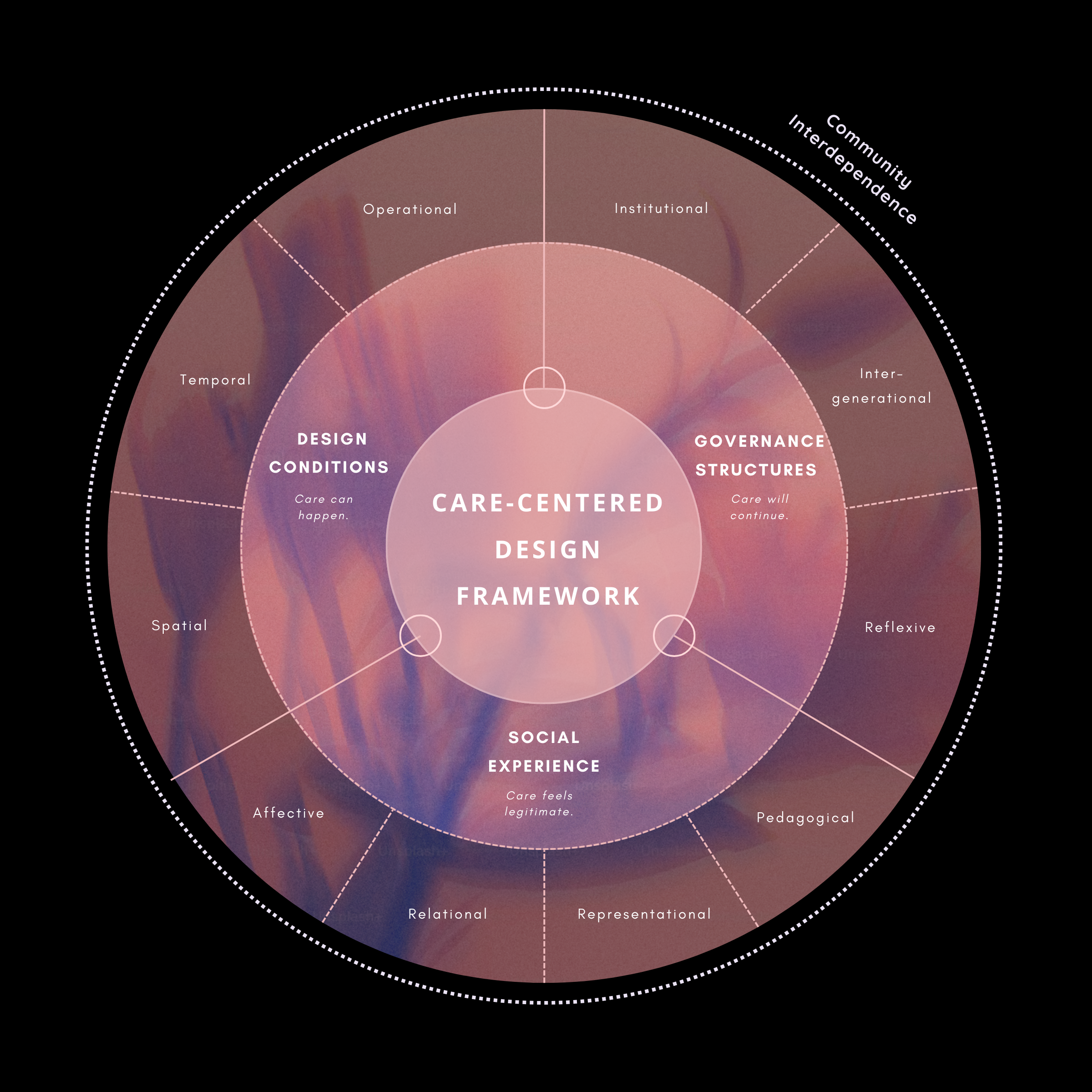
I use qualitative and mixed-methods approaches to understand how people experience systems of care, work, and urban life. My research combines embodied observation (documenting my own experiences as a caregiver navigating public institutions), semi-structured interviews with caregivers and elders, spatial documentation and analysis, and institutional case studies. The goal is generating insights that inform both strategy and implementation—bridging lived experience with systemic design. This research produces frameworks like the Care-Centered Design Framework, comparative analyses across welfare regimes, and design requirements that emerge from caregiver expertise.
-
I analyze how built environments either enable or foreclose care relationships, drawing on embodied observation as a caregiver and years of spatial problem-solving through workshop and program design. This includes documenting existing configurations (circulation patterns, amenities, sightlines), identifying design failures, and proposing concrete interventions: signage systems, furniture reconfigurations, operational changes like flexible programming or re-entry policies. My focus is on interventions that don't require major capital investment—practical solutions institutions can implement within existing constraints while we advocate for more fundamental redesign.
-
I design and facilitate workshops where caregivers, elders, and community members co-create solutions to infrastructure gaps they experience daily. This involves creating safe spaces for sharing lived experiences, translating those experiences into design requirements, prototyping spatial and organizational alternatives together, and refining solutions through iterative feedback. My facilitation draws on years of practice with diverse communities—from Indigenous groups in the Yukon to urban caregivers across contexts—centering participants as design experts whose knowledge shapes outcomes. Workshops produce spatial prototypes, governance models, and implementation strategies grounded in community wisdom.
-
I help institutions develop strategies and governance structures that treat care as core mission rather than accommodation. This includes organizational assessments using the Care-Centered Design Framework, strategic planning that integrates caregiver needs into operations and programming, policy development (family-friendly policies, accessibility standards, staff training protocols), and governance model design for purpose-built care infrastructure like cohousing and care commons. The goal is embedding care-centered thinking into institutional DNA—not as add-on diversity initiative but as fundamental operating principle that shapes resource allocation, decision-making, and organizational culture.
-
I examine how different policy contexts—market-driven (US), social democratic (Nordic countries), state-engineered (Singapore)—shape possibilities for care infrastructure. This comparative work identifies what's transferable across contexts versus what requires local adaptation, revealing how welfare regimes, zoning regulations, funding mechanisms, and cultural norms enable or constrain care infrastructure development. The analysis produces policy toolkits tailored to specific contexts: municipal strategies for cities with limited public funding, regulatory reforms for enabling care commons, public-private partnership models, and implementation pathways that account for local political economy. This work helps practitioners understand what's possible in their context.
building what doesn't yet exist
.
designing for interdependence
.
building what doesn't yet exist . designing for interdependence .
strategist ● researcher
Designing infrastructures that enable caregivers to thrive in economic, cultural, and civic life.
/ Care-Centered Design Framework — Analytical tool for evaluating institutions
/ Institutional Assessments — Museums, libraries, cultural centers
/ Comparative Research — Examining care infrastructure across different welfare regimes
/ Participatory Design Workshops — Co-creating prototypes with caregivers and elders
/ Municipal Strategy Development — Policy frameworks for care as public infrastructure RECOGNITIONMy practice in participatory design, facilitation, and systems thinking has been recognized through keynote presentations, publications, and collaborations with organizations like Google and DesignSingapore Council. This foundation—built through years designing learning experiences and community programs—now informs my work on care infrastructure.
-
Role: Keynote Speaker, Singapore, 2023
Host: DesignSingapore Council
Summary: Shared insights from eight years of designing equitable learning ecosystems at UpstartED. The talk explored how design strategy, participatory methods, and evaluation can nurture belonging, agency, and changemaking among youth and educators. -
Role: Contributor, Chapter, 2021
Publisher: Harvard University / UNESCO collaboration
Summary: A chapter offering design-informed recommendations for multilingual learners, connecting classroom practice with policy and futures-of-education frameworks. Focus areas include equity, participation, and system-level implementation. -
Host: Google Canada, 2023
Summary: Invited to lead two national sessions at Google’s STEM Roundtable, convening community partners, educators, and industry leaders to explore the role of design in advancing equity and measurable impact. Facilitated Learning Experience Design for Impact and Impact Evaluation & Reporting, bridging practice, evidence, and systems thinking to strengthen collective capacity for social innovation. -
Summary: Selected as one of 30 Canadian entrepreneurs to represent social innovators and purpose-driven business leaders at the G20 YEA Summit in Fukuoka, Japan, in 2019.
Contributed to policy discussions and communiques focused on social innovation, sustainability, and the role of design and education in shaping equitable economic systems. Engaged with delegates from 20 member nations to strengthen cross-sector collaboration and share Canada’s perspectives on inclusive entrepreneurship and education for the future of work.